Here’s what you need to know about the carbon tax in N.B.

You may have noticed some curious posts about the federal carbon tax on the Government of New Brunswick’s Facebook Page and website. Premier Blaine Higgs’ Progressive Conservative government’s materials on the carbon tax and what it will mean for New Brunswick cherry-picks facts about the issue, misconstrues how we got here, and (until recently, after […]

Here’s what you need to know about the carbon tax in N.B. Read More »
Corbett talks NB’s biggest carbon polluters with Acadie-Nouvelle

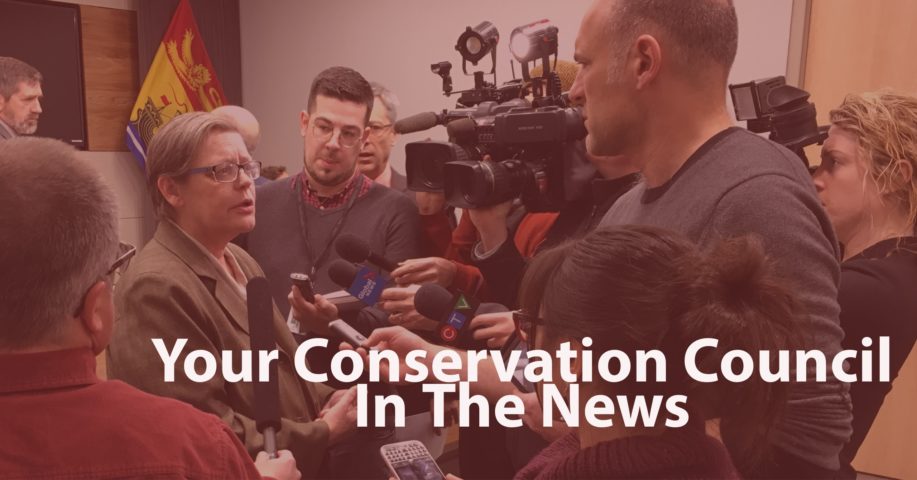
Our Executive Director, Lois Corbett, spoke with L’Acadie Nouvelle this week about the provincial government’s proposed “made-in-New Brunswick” carbon pricing plan for large industrial polluters and the province’s carbon pollution reduction targets. In new materials distributed on the Government of New Brunswick’s website and Facebook page, the province is claiming it is well on its

Corbett talks NB’s biggest carbon polluters with Acadie-Nouvelle Read More »

The ABC’s of carbon pricing and industrial polluters

Having a hard time wrapping your head around carbon pricing plans for large industrial polluters? The federal backstop. A new “made-in-New Brunswick” plan. Which is better? How do they work?  Fortunately, our Executive Director Lois Corbett can shed some light, in simple language, on what carbon pricing is all about and what we should watch

The ABC’s of carbon pricing and industrial polluters Read More »

On World Water Day, Conservation Council calls for immediate action on Water Protection Strategy

Marking the 26th annual World Water Day (March 22), the Conservation Council of New Brunswick calls on the provincial government to take immediate action on the commitments made on the Water Protection Strategy released in December 2017. In that strategy, the provincial government committed to: Introducing a new Water Protection Act by 2020, legislation that

On World Water Day, Conservation Council calls for immediate action on Water Protection Strategy Read More »

Be weary of “sweetheart deal” between industry and province on carbon pollution: Corbett

Our Executive Director Lois Corbett says she’s keeping a close eye on the province’s proposed new carbon-pricing plan for large industrial polluters to ensure it doesn’t let the powerful industrial lobby in New Brunswick off the hook when it comes to meaningful action to reduce carbon pollution. “We don’t need the huge industrial lobby in

Be weary of “sweetheart deal” between industry and province on carbon pollution: Corbett Read More »

EcoNews — Striking for climate solutions, budget highlights, celebrating a new MPA, and remembering Peter DeMarsh

In this edition of EcoNews, we bring you photos and a recap of the inspiring day of climate action in N.B. and across the planet last Friday; we bring you climate action highlights from the federal budget and (the lack thereof in) the provincial budget; we celebrate the newest offshore marine protected area in the

EcoNews — Striking for climate solutions, budget highlights, celebrating a new MPA, and remembering Peter DeMarsh Read More »

Conservation Council welcomes $1B investment in energy efficiency, long-awaited incentives for electric vehicles, and support for coal workers in N.B.

FREDERICTON — The Conservation Council is pleased to see investments in Budget 2019 to make homes more comfortable, affordable and energy efficient, encourage the spread of cleaner vehicles across Canada, and help coal workers in northern New Brunswick prepare for the 2030 phase out of coal-fired electricity. Budget 2019 acts on the recommendations of the

Conservation Council welcomes $1B investment in energy efficiency, long-awaited incentives for electric vehicles, and support for coal workers in N.B. Read More »

One protected area is good, a fully connected network of marine protected areas is better

The Banc-des-Américains (American Bank) Marine Protected Area (MPA) received final approval on March 6, 2019 and is now the largest offshore protected area in the Gulf of Saint Lawrence (GSL). The final boundaries are shown below and encompass an area of one thousand square kilometres (1,000 km2). Protection objectives for the area are to promote

One protected area is good, a fully connected network of marine protected areas is better Read More »

Scroll to Top